
Without a Hook
POWER BALLAD, John Carney’s latest film, timidly taps the dark side of the music business

BUT FIRST…
Hello, stranger. It’s been awhile. Not the first time weeks or even months have passed between entries.
The dry spell usually happens around the same time each year, from late February to early April when things begin to ramp up at the Chicago Latino Film Festival (CLFF), where I’ve held the seasonal position of Press Relations Coordinator/Communications Manager for close to 15 years. Those of you who have worked at a film festival know how intense the weeks leading up to the main event can be and how, more often than not, you do not even have the time to watch a single film (although I did manage again to catch quite a few this year).
And how did the 42nd edition of the Festival, held April 16-27, turn out, you ask? Why, very well, thank you very much: the Festival had its best post-pandemic run, beating last year’s numbers with an increase of 51% in sales (including merchandise) and a 30% increase in attendance. You can read all about it here. Alas, I did not contribute a single blog item this year to the Festival’s website like I have in years past; that’s how hectic and intense this edition was. In fact, I still don’t know how the hell I managed to write two reviews for Third Coast Review (for Calle Málaga and The Blue Trail).
I’m now getting back into the swing of things. Outside of this blog and my occasional contributions to Third Coast Review, I will also be writing for Cinelandia, a newsletter-first publication dedicated to recommendations, criticism, and interviews that started out 12 years ago as a website tracking Latino film screenings across the country. I’m joining a team of writers which includes Cinelandia editor and founder Vanessa Erazo, —who was my editor at Remezcla and my supervisor at Netflix where, for a brief period, I was part of their editorial insights team— and critics Carlos Aguilar and Tiffany Vazquez. My first contribution will go out June 24th, so subscribe now if you want to keep up to speed with what’s happening in Latin American and U.S. Latino cinema.
I want to wave a big WELCOME and HELLO signs to the tidal wave of new subscribers who signed up to read my ramblings on new films and the occasional book or music recommendation (which, come to think of it, I haven’t done in a while). I hope you had a chance to catch up on the last couple of years of cinematic musings.
An equally big thank you to Puerto Rican film critic and programmer Mario Alegre Femenías for recommending this space on the web. Mario is doing the Good Lord’s work in the island by successfully bringing back to the big screen some all-time favorites like The Wizard of Oz, Thelma and Louise and Goldfinger, a whole series devoted to the work of Christopher Nolan leading up to the release of his latest, The Odyssey, as well as a Lynch and a Kurosawa retrospective. I suspect he also had a hand in bringing the American Cinematheque’s Bleak Week: Cinema of Despair series to the island. I mean…Bela Tarr’s Werckmeister Harmonies in Puerto Rico? Who would have thunk it?
Watching Kurosawa’s Dreams, as part of his retrospective, in a packed house at the Fine Arts Miramar during my recent trip to Puerto Rico, 36 years after I saw it for the first time at Chicago’s Fine Arts Theater (today the Studebaker Theater), was more than a treat. It took me back to the years when the island’s only art house cinema, the three-screen Cinearte in Hato Rey’s banking district owned by film critic turned filmmaker Juan Gerard, was the only place where you could experience Fassbinder’s full work and even watch half of Kevin Brownlow’s restoration of Abel Gance’s 1927 six-hour epic Napoleon. Today, most foreign-language offerings in the island are limited to a large number of cheesy Spanish-language comedies from Spain and Latin America with the occasional Academy Award winning title, the occasional film festival, or new Puerto Rican film thrown in for good measure. The fact that Mario’s retrospectives and special series are playing to packed houses in the island makes me very happy.
And now, onto this week’s review…
JOHN CARNEY IN A MINOR KEY
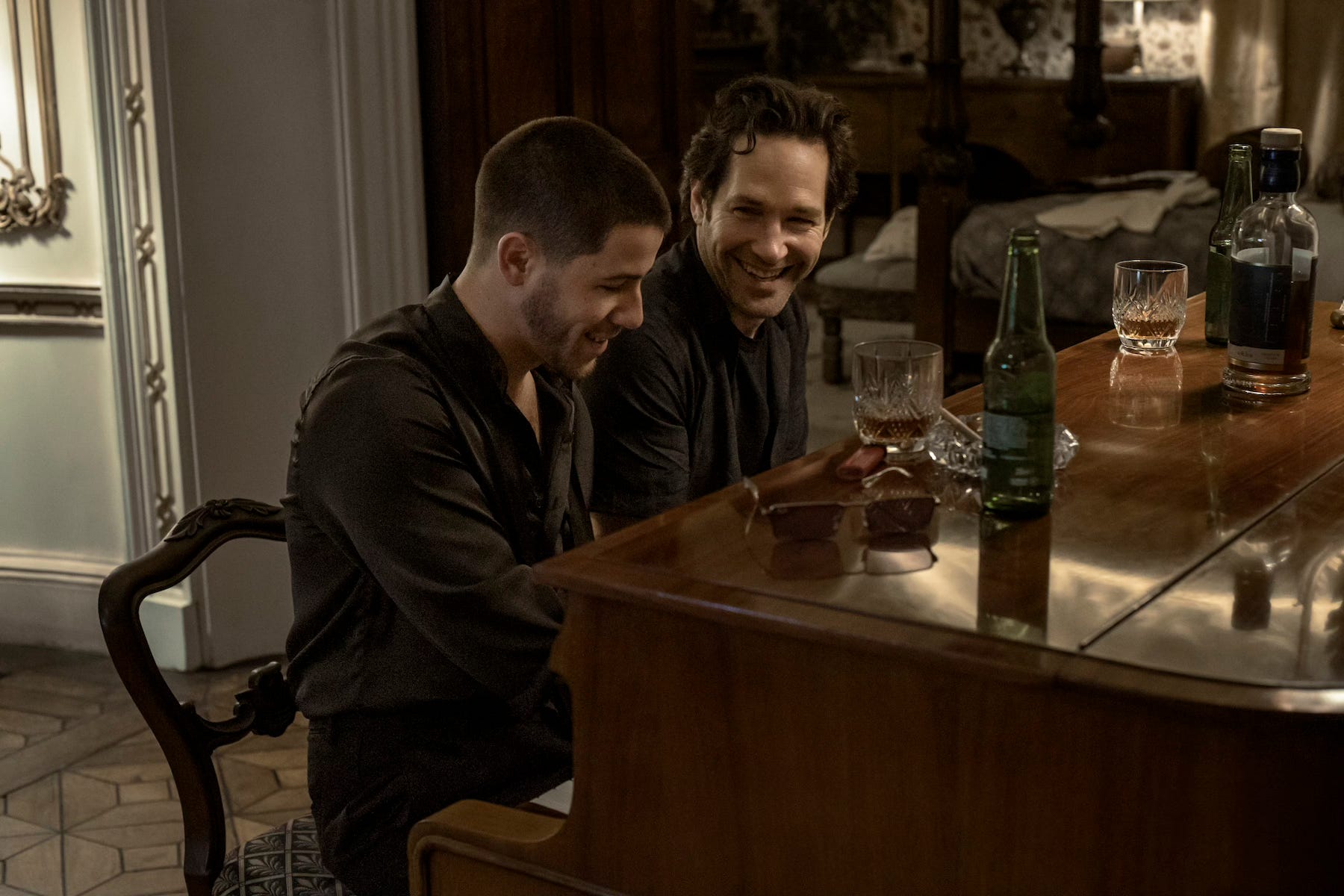
John Carney’s Power Ballad, which opened wide June 5 after opening in select markets the weekend before, was the first new release I saw post-CLFF and, frankly, I wished I had liked it more. There is a generic quality to it that I found quite disconcerting, a feeling that Carney seems to be stuck in a rut. His films post-Once (2006), —a humble, modest, uplifting jewel of a film—, all follow the same formula: they involve music in some way, shape or form (especially if a guitar is involved), tons of rehearsal and jam sessions, and a friendship or romance or parent-son relationship between its two leads that devolves into some type of conflict. They are all about the joy of collaboration and the power songs have in our lives. I wish I had derived more joy from his latest film. But Power Ballad is a flat, disappointing affair, with underdeveloped characters that could be described in one line and a story that feels slightly uncooked.
Paul Rudd plays Rick Power, a Kansas-born and raised guitarist and lead vocalist for wedding cover band The Bride and Groove who gave up his dreams of being a rock and roll star and playing in big venues like Madison Square Garden after meeting his now wife Rachel (Marcella Plunkett) while on tour with his old band in Ireland 15 years ago. He still writes songs and he still dreams of making it big as a singer-songwriter/rock star. But dreaming doesn’t pay the bills, especially when you are the father of a 14-year-old daughter in suburban Dublin.
It is precisely at one of these weddings at a luxurious mansion where he befriends Danny (Nick Jonas), a former boy-band star trying to launch his solo career, after the bride and groom ask Rick and his band if they can let Danny join them for one number. Later that evening, as he strolls the grounds of the estate, Rick runs into Danny who invites him for a beer inside his room full of sound equipment, guitars, a mixing board and a piano. You know they will inevitably share riffs and ideas for unwritten songs, that they will be noodling with chords and harmonies, and that they will talk about music, songs and the meaning of life. Welcome to Carneylandia, where such scenes are par for the course. But unlike Once, this one will not make you feel like you are listening; it lacks the emotional punch that made such scenes in Once sing, pun unintended.
Back in Los Angeles, Danny is still trying to find that sound and that song that will kick start his solo career. Months later and miles apart, in an Irish mall, Rick’s ears perk up when he listens, through the mall’s sound system, to a song that sounds pretty familiar. Which it turns out to be: “How to Write a Song Without You,” the one incomplete song Rick shared with Danny that evening and which is now a hit for the former boy band star. From that moment on, the film follows Rick’s attempts to reclaim his song, not an easy task given that he has no record of having ever written it: no video or audio recordings, no notes scribbled on a piece of paper, nada. His wife doesn’t believe him, his daughter hardly believes him, his bandmates don’t believe him…well, except for Sandy (co-writer Peter McDonald) a low-rent Begbie always ready for a good fight or two. With Danny’s manager threatening legal action and with the song blasting everywhere (Rick even gets a request to perform it at a wedding), Rick begins to lose his cool…as well as his job and, almost, his family. With nothing else to lose, he convinces Sandy to fly with him to L.A. to confront Danny in a final act that defies all narrative logic.
There are hints throughout of what Rock Ballad could have been: a journey to the dark side of the music business where dreams are dashed, where performers and their managers will do whatever it takes to survive and score that hit even if it involves stealing somebody else’s intellectual property. It’s also about mid-life crises and generational gaps. And while Carney’s decision not to make Danny a complete asshole is admirable, it also robs the story of any potential dramatic conflict.
Rock Ballad is a movie in conflict with itself. It wants to be both a lighthearted comedy and a look into the emotional toll of having your work stolen from you. It wants to give Rick a happy ending, when, in fact, there is no happy ending in real life. But it keeps pulling its punches. If only that song Rick is fighting for (written by Carney and Gary Clark) was that good and memorable.
Rock Ballad is, let’s face it, more Paul Rudd’s film than Carney’s. It almost feels tailor-made to his amiable, everyman, mensch-like persona. It’s hard not to feel any sympathy for Rick or any of the other characters Rudd has played in the past even when they are cads or their morals leave a lot to be desired. There is an easy, effortless rhythm to his performance, even when the script asks him to tap into something darker, even desperate. In other words, Rudd saves the film from itself.
Great to hear from the Culture Bodega again! 🎇