

I wish we didn’t live in such a spoiler-phobic world, where arts critics have to tippy-toe around how much to reveal of a narrative work’s plot or story. Especially when the work demands deeper consideration. I wish we didn’t always have to worry about the hordes of anonymous social media warriors who demand our heads on a pike if we so much as reveal one plot detail. So what to do when it comes to Steven Spielberg’s new film Disclosure Day, a work that not only marks the culmination of his interest in extraterrestrial life (at least when it comes to his movies) but that is in direct dialogue with Close Encounters of the Third Kind, released 49 years ago? Fortunately, with his spoilery trailers for the film, Spielberg has slightly opened the door for us, critics and audiences alike, to engage in that dialogue. Granted, those trailers don’t give everything away; they are, as most trailers should be, an invitation to be part of a journey, one that is thrilling and can be thought-provoking.

Spielberg, more than any other filmmaker that has dabbled in science-fiction, is a product of the pulp magazine era. He himself has acknowledged the influence such magazines as Amazing Stories, Astounding and Galaxy had on his feverish imagination. These are the magazines that, after all, published the work of Isaac Asimov, Robert Heinlein, and Frederick Pohl among many of the (mostly white) giants of the genre. Spielberg understands that what makes a good science-fiction story tick is that precise combination of brain and brawn, of action and ideas. But, most importantly, their ability to convey a sense of wonder, of the many mysteries that are beyond our grasp. That these stories talk not only about the human condition but its potential. His obsession with the existence of extraterrestrial life is driven by that core question of a good science-fiction story…what if.
But in the case of Disclosure Day (even the title is a spoiler), the question is more than what if, it is how we would react upon the news that we are not alone and why have we been driven so far apart? Whereas in Close Encounters of the Third Kind only a privileged few (scientists, the military, and a determined and obsessed civilian by the name of Roy Neary) have exclusive access to the news that, yes, Virginia, we are not alone, in Disclosure Day not only is the truth out there but it will be revealed to the whole planet no matter what the U.S. government and their military complex do to stop it from coming out, damn the consequences.
Disclosure Day starts in media res with the most literally in-your-face shot of Spielberg’s filmography, one that immediately drags you, kicking and screaming, into the film. His camera soon focuses on one of the film’s two protagonists, Daniel Kellner (Josh O’Connor), a government cybersecurity expert who, we soon find out, has stolen from his employer, Wardex, more than a dozen hard drives containing incriminating evidence about the government’s involvement in covering up the existence of extraterrestrial life as well as a powerful alien device. He’s soon surrounded by security officers working for Wardex and the head boss himself, Noah Scanlon (a perfectly cold and slimy Colin Firth). Daniel is there to exchange his backpack containing the drives and device for his girlfriend, a badly beaten Jane (Eve Hewson), but soon flips the table on them, taking his backpack and girlfriend with him, jump starting the chase that started long before that opening shot.
Daniel is part of a group of former Wardex employees who one day up and leave the company alongside company executive Hugo Wakefield (Colman Domingo) who wants to open Pandora’s Box of extraterrestrial information. Wakefield is the ying to Scanlon’s yang. Scanlon is the cold, calculating, apparatchik who will stop at nothing to make sure he retains control of all the information and technology. Hugo is the empath, the man with the soothing, trusting voice hasn’t lost his faith in humanity and its ability to grasp the inconceivable. Both believe they are working in the country’s, and the world’s, best interests, especially as the world faces what could be a cataclysmic war between North and South Korea and the United States.
Meanwhile, in Kansas City, meteorologist Margaret Fairchild (Emily Blunt) suddenly finds herself speaking in Russian after a red cardinal flies into her and her boyfriend’s loft. On her way to work, she discovers that she has suddenly acquired the ability to read people’s minds, providing advice to a traffic cop who stops her for speeding, and to her news team. Things go sideways for Margaret when, as she delivers her weather report, she starts speaking in a series of clicks and guttural sounds before collapsing. This also catches the attention of both Scanlon and Wakefield; while one sends his goons after her, the other gives Margaret one simple command over the phone: go east. Wakefield also sends Daniel a link to the broadcast; Daniel claims that he can understand her and that she is speaking English.
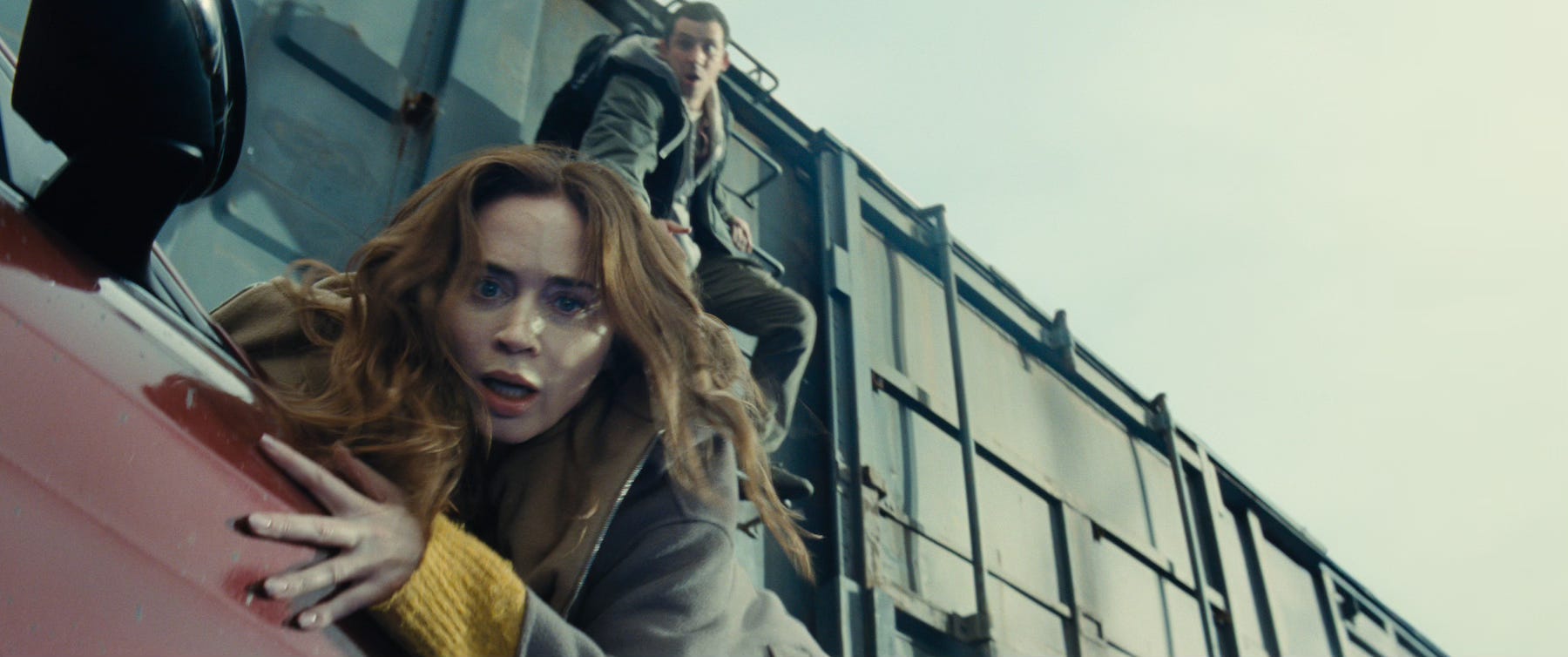
The trailer gives away the fact that Daniel and Margaret were both abducted at the same time. And even if you managed to avoid it, you know that plot mechanics will bring them together. Their converging storylines lead to one of the top action sequences of Spielberg’s filmography involving Margaret’s car and a speeding train. Crisply edited and shot, the sequence is a master class in action direction, one that should be required viewing for the folks putting together the final Fast and Furious film or any film involving car chases and crashes.
Disclosure Day is a film in perpetual motion. Janusz Kaminsky’s and second unit photographer Patrick Capone’s cameras hardly ever stand still, especially during the film’s first 90 minutes. They move parallel to the characters, they crane up and down; one even flies from behind a laptop, flips upside down and then rightside up to show us what is on its monitor. Even when it is standing still, the objects around it are in full motion. And yet, unlike many contemporary blockbusters, Spielberg gives his story room to breathe, for its characters to figure out what’s next and even have deep conversations about faith and humanity. He knows that thrills are not enough; that you need to offer audiences a full, satisfying meal. He’s been doing so for more than five decades.
Disclosure Day is a film about opposites and dualities. Daniel and Margaret represent opposite sides of the human condition just like Scanlon and Hugo. Daniel, in his recently acquired knowledge of complex mathematical formulas, represents our rational, science-driven side while Margaret, just like Hugo, is our more empathic, kind, humane side (the aliens’ gender-based potioning of talent is as antiquated as some of the stories from the golden era of science-fiction). Kaminski’s light scheme and choice of formats points to this duality as well: bright, shiny, digital, cold photography for the TV studios and Wardex’s interiors, a more muted, sometimes grainy, definitely warm one for most of the film.
It’s easy, when writing about a new Spielberg, to be wowed by his technical and storytelling prowess. We forget that he is also a great director of actors. While the characters, at least on paper, feel a bit thin, Spielberg gives O’Connor, Blunt, Firth, Domingo and particularly Hewson —whose character, one feels, got the short end of the stick either on the script’s final draft or on the cutting room floor— the space to flesh them out. Hunched over through most of the film not only by his backpack but by the weight of his decision, O’Connor delivers a performance that is at once nerdy, sensitive and borderline paranoid but that also asks his character to turn into a man of action at a moment’s notice out of sheer survival and desperation. I always derive great joy from listening to Domingo’s silky, soothing voice, which he makes great use of here as the calm in the middle of the oncoming storm.

Blunt delivers a far more complex performance, one that could easily be taken for granted given all the on-screen activity. As Margaret, Blunt is asked to deliver a wild mix of emotions sometimes in a single scene as her character grapples with these new abilities. If voice is Domingo’s secret weapon, the eyes are Blunt’s: her gaze is intense one minute and comforting and reassuring the next. In them you can see how this dynamo of a woman begins to come to terms not only with past traumas but with the burden she’s been asked to carry by outside forces.
As the former novitiate who lost all faith in humanity and her own faith, Hewson is the film’s soul. Which is why I wish her scenes alongside Elizabeth Marvel as Sister Maura didn’t feel as an after thought given how their core arguments are so fundamental to what Spielberg and Koepp are going after…far more than that one Heat-like scene between Firth and Domingo. The fact that she remains absent in the film’s final third until near the end when she’s used as a convenient plot device, diminishes its power a bit.
If Close Encounters of the Third Kind was about one man’s search for the meaning of what he witnessed, how it wrecks his family and how, in the end, he embraces a sense of wonder, the final minutes of Discovery Day point at how we, as a species, collectively look the other way when that sense of wonder is being destroyed. And here’s what I am getting at when I refer to the spoilerphobic world we live in. Because the sequence following the inevitable release of those videos deserves to be analyzed in full detail. It’s where all those ideas about faith and empathy and looking the other way come together. I will say this: even though in Close Encounters of the Third Kind, humanity looks up at the sky in wonder and in Disclosure Day, they look down at their screens in horror, Spielberg, the eternal optimist, still believes in the redeeming power of truth and of the good that is within us. All you need to do is…listen.